
22 Jul The Politics of Reclaiming a Chai Stall
Walk through any Indian city and you are likely to pass several roadside chai (tea) stalls. They stand outside offices, college meeting points, beside markets, near metro stations and at neighbourhood corners. People stop for a quick cup before work, during a break or on their way home.
Over time, these stalls have become much more than places to buy tea. They are where colleagues catch up, neighbours exchange news and conversations continue long after the tea is finished, making tea stalls an informal leisure or meeting point. Yet, despite being an accessible public space in our cities, they are deeply gendered. Spend a few minutes at almost any chai stall and you’ll quickly notice that the people who linger and occupy these spaces are overwhelmingly men.
Research on gender and mobility highlights that the inequalities women experience in cities are not only about unequal access but also about unequal entitlement to public space (Phadke et al., 2011) Women’s everyday mobility is shaped by their dual responsibilities of paid work and unpaid domestic and care work, resulting in complex travel patterns structured around work, caregiving and household responsibilities (Visakha, 2021). Leisure, by contrast, has historically been constructed as a masculine activity. As a result, women’s presence in streets, markets and neighbourhood gathering spaces continues to be read through the lens of purpose. Occupying public space without a destination, a task or a justification remains socially difficult, revealing that the ability to linger is itself unequally distributed.
It is this unequal entitlement to public space that the concept of the “right to loiter” seeks to capture. Women’s freedom in the city cannot be reduced to safe mobility alone. An equal claim to the city also requires the freedom to remain in public without having to account for their presence. The “right to loiter” challenges the expectation that women’s presence in public must always be justified through work, caregiving, or other socially accepted purposes. Rather than focusing solely on women’s ability to move safely through the city, it emphasises their equal right to inhabit and occupy public spaces.
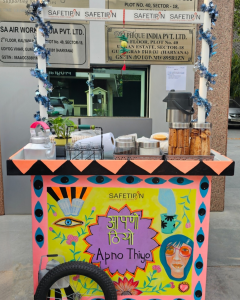
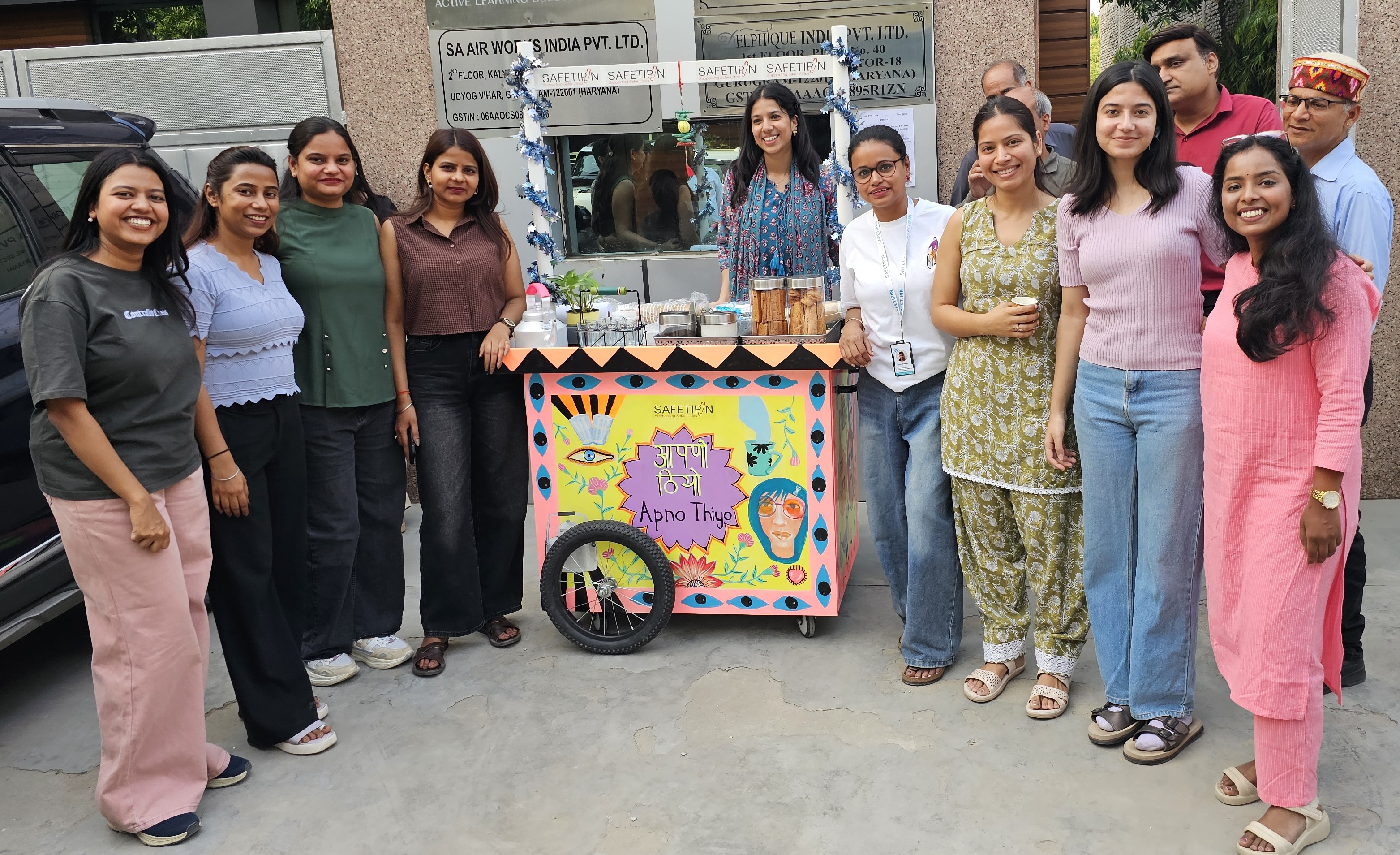
This thought inspired Apno Thiyo, Safetipin’s pop-up chai stall, created to reclaim an everyday public space that had long felt more welcoming to men than women. In Gurugram, the stall became a gathering point for working women, who stepped out of their offices to share tea, conversation and claim a space that was normally dominated by men. Their presence unsettled familiar assumptions about who belongs at roadside chai stalls and who is expected to occupy them.
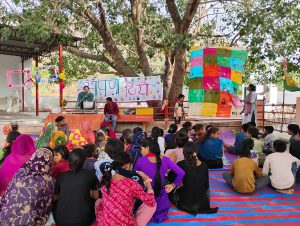
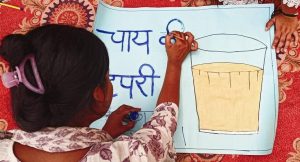
In Ajmer, the intervention was led by five young women, Monika, Shubhangini, Pooja, Tanu and Manju, from the Cities for Youth programme. Their starting point was not the chai stall itself, but the question of women’s expression in public space. For them, Apno Thiyo created a space where women could express themselves freely, emotionally, physically and socially, while reimagining who belongs in and feels entitled to an everyday public space.
A roadside chai stall may seem like a small part of city life, but it reveals how deeply gender shapes access to public spaces. Through Apno Thiyo, Safetipin made these deeply ingrained inequalities visible. The conversations around the stall became conversations about access, exclusion and who gets to spend time in public without their presence being questioned.
References:
Phadke, S., Khan, S., & Ranade, S. (2011). Why loiter? Women and risk on Mumbai streets. Penguin Books India.
Visakha, S. (2021). Making a feminist city: Planning safety and autonomy for women – A legal and policy perspective. Vidhi Centre for Legal Policy.